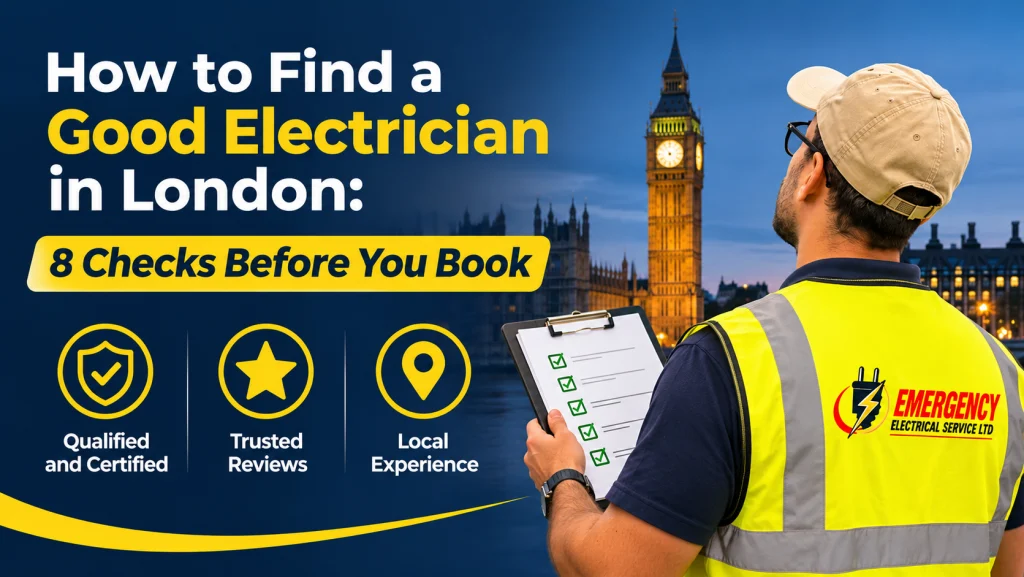
A good electrician is registered with a government approved scheme such as NICEIC or NAPIT, carries public liability insurance, has recent reviews from real local customers, agrees a price before starting, and gives you the right certificate when the job is done. You can check registration in two minutes on the official Electrical Competent Person Register.
Finding an electrician in London is easy. Finding a good one is harder. Search “electrician near me” and you will see dozens of names, all promising to be fast, reliable and fairly priced. Most are. Some are not, and electrical work is not a trade where you want to find out the hard way.
Poor electrical work is not just untidy. It can leave hidden faults behind walls, invalidate your home insurance, cause problems when you sell, and in the worst cases start a fire. This guide gives you 8 simple checks to make before you let anyone work on your electrics.
Speak to a Local Electrician: 020 3504 2412
Check 1: Are they registered with a competent person scheme?
This is the most important check, and the one most people skip.
In England, a lot of electrical work in homes is covered by Part P of the Building Regulations. Work such as new circuits, rewiring, or work near a bath or shower is “notifiable”, which means it has to be certified as safe.
Electricians registered with a government approved competent person scheme can certify their own work. The best known schemes include NICEIC, NAPIT and ELECSA. To join, electricians are assessed on their qualifications and the quality of their work, and they are checked again regularly.
How to check: search the electrician or company name on the Electrical Competent Person Register. It was set up with government backing to help people steer clear of rogue electricians, and lists electricians from all the approved schemes in one place. You can also use the Electrical Safety First register.
Searching “NICEIC electrician near me”? NICEIC is one of several approved schemes. An electrician registered with NAPIT or ELECSA meets the same government standard. What matters is that they are on an approved register, not which one.
Check 2: Do they have public liability insurance?
If something goes wrong, such as a cable drilled through a water pipe or damage to your property, insurance means you are not left paying for it.
Ask: “Do you have public liability insurance, and how much does it cover?” A professional electrician will answer straight away and can send you proof.
Check 3: Are their reviews real, recent and local?
Reviews are one of the best ways to judge an electrician, as long as you read them properly.
Look for reviews that:
- Are recent, from the last few months
- Describe real jobs, such as “fixed our RCD that kept tripping”
- Mention local areas, so you know they actually work near you
- Have owner replies, which show the business cares about feedback
Be wary of:
- Lots of short five star reviews posted on the same day
- Reviews that describe a completely different trade
- A business with no reviews at all on Google
Check Google first, because those reviews are tied to a real business listing with a location. Independent sites such as Checkatrade and TrustATrader are useful too.
Check 4: Will they agree a price before starting?
A good electrician tells you the cost before work begins. For emergency callouts, that means a callout price confirmed on the phone. For bigger jobs, such as a rewire, it means a written quote.
Red flags:
- “We’ll see when we get there” with no figure at all
- A quote that is far lower than everyone else’s, which often means extras later
- Pressure to agree to expensive work on the spot
If you are comparing quotes for planned work, check that each one covers the same things, such as testing, certificates and making good walls.
Check 5: Will you get a certificate?
Every electrical job should end with paperwork. Which certificate depends on the work:
| Type of work | Certificate you should receive |
| Repair or small addition, such as a new socket on an existing circuit | Minor Electrical Installation Works Certificate |
| New circuit, rewire or major installation | Electrical Installation Certificate |
| Notifiable work under Part P | Building Regulations compliance certificate |
Keep every certificate. You will need them when you sell or let your property, and your insurer may ask for them after a claim.
Ask: “Which certificate will I get for this job?” If the answer is vague, look elsewhere.
Check 6: Do they cover your area, and how fast?
A local electrician is not just more convenient. They can reach you faster in an emergency, they know the typical problems with local housing, and they are easier to get back if anything needs a follow up.
Ask: “Do you cover my postcode, and how long does it usually take you to get here?” You want a realistic time, not “soon”.
Check 7: Do they explain things clearly?
A good electrician explains the problem in plain English, tells you your options, and does not pressure you. You should come away understanding what was wrong and what was done.
If someone uses jargon to rush you into a decision, or will not explain why a big job is needed, that is a reason to get a second opinion.
Check 8: Do they have a real business behind them?
A company name, a business address you can look up, a landline or established mobile number, a website and a Google Business Profile all show that a business is accountable. If something goes wrong, you know where to find them.
Be cautious of traders who only give a first name and a mobile number, ask for cash only, or cannot give you a company name for the invoice.
Questions to ask an electrician before you book
Save this list for your next call:
- Which competent person scheme are you registered with?
- Do you have public liability insurance?
- Can you confirm the price before you start?
- Which certificate will I receive?
- How soon can you get here, and do you cover my area?
- Will you explain what you find before doing any extra work?
- Do you take card payments?
Warning signs of a rogue electrician
- Knocks on your door offering electrical work you did not ask for
- Cannot or will not show registration or insurance
- Insists on cash, or a large payment upfront
- Pushes you to decide on major work immediately
- Leaves without giving you a certificate
- Has no reviews, or reviews that do not match the work
If you have any doubts, stop and check the Electrical Competent Person Register before going ahead.
How Emergency Electrical Service Ltd measures up
We wrote this checklist because we are happy to be judged by it. Here is how we answer each check.
| Check | Emergency Electrical Service Ltd |
| 1. Registered with an approved scheme | [Scheme name and registration number, to be confirmed] |
| 2. Public liability insurance | [Cover level, to be confirmed] |
| 3. Real, local reviews | Rated 5.0 on Google by customers across London |
| 4. Price agreed first | We confirm the price before any work starts |
| 5. Certificates | Every job tested to BS 7671, with the right certificate issued |
| 6. Local and fast | Based in Covent Garden, covering Central London, Wimbledon, Tooting, Croydon and Norbury, average arrival around [X] minutes |
| 7. Clear explanations | We show you what we found and explain your options before any extra work |
| 8. A real business | Emergency Electrical Service Ltd, 71 to 75 Shelton Street, London WC2H 9JQ |
And unlike many electricians, we answer the phone 24 hours a day, 7 days a week. If you need us at 2am, a real person picks up. Read more about what to expect from an out of hours electrician.
Call 020 3504 2412
What we can help with
- RCD tripping repair when your power keeps cutting out
- Electrical repair and fault finding for burning smells, dead circuits and flickering lights
- Socket installation and repair for new, extra or damaged sockets
- Full property rewiring for older homes
- Electrical installation for lighting, new circuits and refurbishments
Local electricians across London
We cover:
- Electrician in Central London
- Electrician in Wimbledon
- Electrician in Tooting
- Electrician in Croydon
- Electrician in Norbury
Frequently asked questions
How do I find a good electrician near me?
Check they are on the Electrical Competent Person Register, ask about insurance, read recent local Google reviews, and make sure they agree a price and tell you which certificate you will receive before they start.
What is a NICEIC electrician?
An electrician registered with NICEIC, one of the government approved competent person schemes. Registered electricians are assessed regularly and can certify their own notifiable work under Part P. NAPIT and ELECSA are other approved schemes that meet the same standard.
How do I check if an electrician is registered?
Search their name or company on the Electrical Competent Person Register. It covers electricians from all the government approved schemes.
Do I need a registered electrician for small jobs?
Not every job is notifiable, but using a registered electrician means the work is done and tested to the national standard, and you get a certificate. That protects you when you sell, let or claim on insurance.
What questions should I ask an electrician?
Ask which scheme they are registered with, whether they have insurance, what the job will cost, which certificate you will get, and how soon they can arrive.
What should I do if an electrician leaves without giving a certificate?
Contact them and ask for it. If they will not provide one, contact the scheme they claim to belong to, or your local council’s building control team for notifiable work.
Need a trusted electrician in London?
Use the checklist. Then call us and ask us every question on it. We will answer them all, confirm the price before we start, and get a local electrician to you, day or night.
Call 020 3504 2412
Looking for an emergency electrician in London? We are on call 24/7.